Spring freshet under way across Saugeen watershed
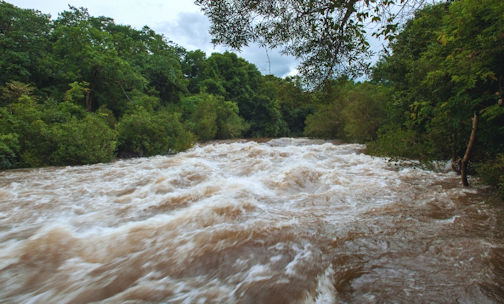
The Saugeen Valley Conservation Authority (SVCA) is monitoring rising water levels across the Saugeen watershed as warm temperatures, rainfall, and melting snow combine to drive the annual spring freshet (run-off).
While spring flooding is a natural part of life in Ontario watersheds, the way rivers respond is shaped by the health of the landscape around them. Watersheds with strong wetland systems, forest cover, and natural vegetation along riverbanks, tend to absorb and slow water during rain and snowmelt. Areas with fewer natural buffers often experience sharper spikes in water levels and faster run-off.
Events, such as the current freshet, offer a clear reminder that protecting natural spaces is not only an environmental priority, but essential for community safety, infrastructure protection, and local economies.
Over the past several days, rainfall and rapid snowmelt have produced significant increases in water levels across many rivers and streams in the Saugeen watershed. Monitoring stations throughout the system show rising flows over the past 24 hours, with some rivers responding quickly as run-off moves through the landscape.
Current monitoring data shows substantial increases in stream flow at multiple locations across the watershed. One of the most notable conditions during this event has been record high flows observed in the Pine River, which responds quickly to rain and snowmelt.
“Flood events remind us that watershed management happens long before the water rises," says Erik Downing, SVCA general manager/secretary-treasurer. "Through local monitoring, conservation land management, and regulating development, the SVCA works to monitor and protect the natural systems that store and slow water. All of that work helps reduce flood risk and protect people and property.”
SVCA staff has been working throughout the weekend to monitor conditions across the watershed. Staff tracks water levels, rainfall, and snowmelt through a network of flood-reporting stations located across 15 member municipalities.
This information is shared directly with municipalities, emergency management staff, and first-responders, allowing for co-ordinated local response and timely public communication. The SVCA uses this data to issue flood statements and updates as conditions evolve.
WHY LANDSCAPE MATTERS
Not all rivers respond to rainfall and snowmelt in the same way. Rivers, such as the Pine River in Huron-Kinloss Township and the Penetangore River in the Municipality of Kincardine, tend to respond very quickly to precipitation and melting snow. These systems are often described as “flashy,” meaning water levels rise rapidly and flows spike quickly.
One of the reasons for this is landscape condition. The Pine River and Penetangore River sub-watersheds have the lowest levels of forest and wetland cover of the SVCA's 10 sub-watersheds. It is not a coincidence that they also show some of the most rapid and volatile river responses during rainfall and snowmelt events.
Wetlands, forests, and healthy vegetation along rivers, known as riparian cover, function as natural water control infrastructure. These landscapes absorb and store water, slowing run-off and releasing it gradually over time. Without these natural buffers, water moves quickly across the landscape and into rivers, causing faster rises and higher peaks.
Other parts of the watershed behave very differently. Portions of the northeastern watershed, including areas influenced by the Greenock Swamp and the Rocky Saugeen system, contain extensive wetlands and forest cover. These landscapes slow the movement of water, causing rivers to rise more gradually. Peak flows tend to be lower and the crest is spread out over a longer period of time.
This natural buffering effect reduces erosion, lowers pressure on infrastructure, and improves safety for communities. When wetlands, forests, and healthy riverbanks are protected, watersheds respond more moderately to storms and snowmelt.
The Greenock Swamp, home to the SVCA’s Schmidt Lake Conservation Area, provides one of the clearest examples of how natural landscapes help protect communities. The SVCA owns half of this area and protects all of it through permitting review. It is southern Ontario’s largest forested wetland, covering roughly 20,000 acres. Such wetlands act as a natural sponge, absorbing water during heavy rain and snowmelt and releasing it gradually during drier periods, helping stabilize water levels across the watershed. The area is also one of the most ecologically-diverse landscapes in Grey and Bruce counties.
Conservation authorities exist to help communities reduce flood risk, protect natural systems, and guide safe development through environmental planning and regulation. The SVCA works closely with municipalities, landowners, and local partners to monitor watershed conditions, maintaining long-term data-sets that span decades. This long-term monitoring is essential for understanding how watersheds behave over time and supports informed decisions that help protect people, property, and infrastructure.
The public is reminded of the importance of local monitoring and local response during events such as the spring freshet. The SVCA’s immense organizational knowledge, on-the-ground presence, and decades of data, allows municipalities and emergency services to make informed decisions in real time. Supporting local watershed management helps protect communities today and strengthens the resilience of the watershed into the future.
Those interested in watershed conditions, can explore water level, rainfall, snowpack, and water quality data collected across the Saugeen watershed through the SVCA’s public data portal:
www.saugeenconservation.ca/data.
Residents are reminded to use caution around watercourses and monitor local flood messages. Report flooding you see, by using the SVCA portal:
www.saugeenconservation.ca/reportflood.
 Written By
No bio for this author.



Related Stories
No related stories.