


 June 17, 2026
71
June 17, 2026
71
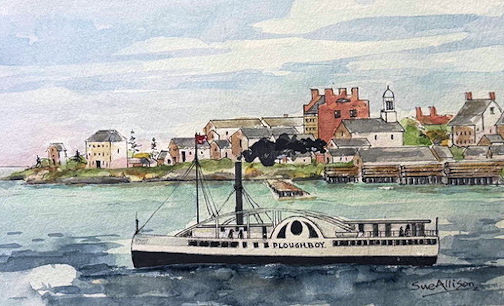
It all began as a pleasure excursion. The sheriff of Simcoe County, Benjamin Walker Smith, had invited premier John A. Macdonald and members of his cabinet on a planned five-day outing to Sault Ste. Marie, aboard the steamer, "Ploughboy." The party left Toronto by train and headed to Collingwood, where the group boarded the "Ploughboy" and departed on July 3, 1859, up-bound for Sault Ste. Marie.
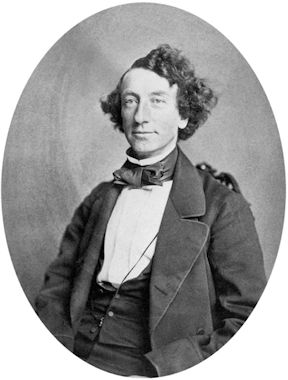 Those aboard included John A. Macdonald, some of the most prominent gentlemen of the province, head officers of government, more than 30 members of the Parliament of Canada West and many others, with friends and family. The "Chicago Press and Tribune" wrote, "...everything promised a delightful voyage for the distinguished company of excursionists." Unfortunately, such was not to be the case.
John A. Macdonald in 1858, a year before his narrow escape in Georgian Bay; photo courtesy of Wikimedia Commons
While on course to Little Current, on Manitoulin Island, the steamer's cross-heads snapped without any explanation. This happened in the North Channel, just off Lonely Island, in Georgian Bay. Mr. Davis, the "Ploughboy's" engineer, could not repair the damage and as a result, the vessel "... was rendered perfectly helpless by the accident" and left drifting dangerously toward rocks on shore. Long accounts of the accident appeared in the July 4 [Toronto] "Colonist," the July 6 [Barrie] "Northern Advance," the July 7 "Detroit Free Press," the July 8 [Kingston] "Weekly Chronicle," the July 8 "Buffalo Express," the July 9 "New York Herald" and many other newspapers.
Eyewitness accounts were also recorded. Passenger John Prince, the recently appointed Algoma Judge, recorded the misadventure in his diary for July 2-3: "We reached 'Owen Sound' at five this morning, and Vankoughnet and most of us were up and admired the place (Collingwood) much. Then at seven (a.m.) we proceeded on our voyage toward Killarney; as usual, en route for The Sault. The sea a little rough, but not too much so, but, about 3 p.m. and a distance about 15 miles from Cabot's Head, and not less than 100 miles from Collingwood, the iron crossbeam of our engine broke in two, and the fine steamer was left at the mercy of the sea and waves! Nobody could hold the smallest command over her rudder or any other part of her! The shore, which is one of the most dangerous and rocky in the world!
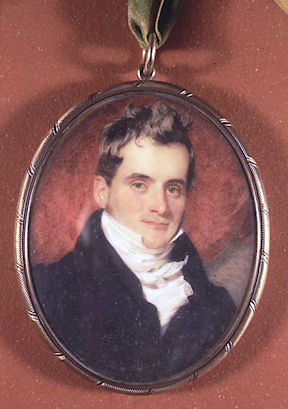 "At 4 p.m. we manned a boat and sent her off to Owen Sound for aid, hoping to find the 'Canadian' S.B. there. We kept on drifting all night. Expecting to go ashore among the rocks and breakers every hour. The ladies behaved cool and admirably, as indeed did everybody else on board. But nothing short of wreck and loss of life stared us in the face. We were miraculously saved by the following event. After drifting toward one of the most rocky, perpendicular and dangerous shores on Lake Huron, and at two o'clock this morning, just as we discovered rocks 100 feet high and within 20 yards of our helpless vessel, the two Ankers which had been out for 12 hours, while we were drifting but which never got anchorage once because of the great depth of the water, suddenly took hold of a ledge of rock, in about 30 fathoms, and close upon the shore, and they held the boat firm!
Miniature painting of eyewitness John Prince, about 1830; photo courtesy of Mrs. H. Henchel and Museum Windsor
"We remained swinging at anchor, not knowing but that she might part with her anchors every minute, and then shipwrecked and loss of, probably, Every soul on board (for swimming in such a place would be useless and the swell and surf were very high). We remained there 'till 12 noon, when the swell and wind abated, and a boat was manned, and by degress, every female and nearly all the passengers went ashore in a small bay about a mile distant, intending to remain 'till relief came. I never left the unfortunate 'Ploughboy' once, as in case of wreck, I thought I could be useful, and no use on the land where so many had gone. The 'Canadian' hove insight, and by 11 p.m., all got on board, and left the rocks."
Other detailed observations from passengers aboard were published in the July 4 "Toronto Colonist" and the July 11 "Chicago Press and Tribune."
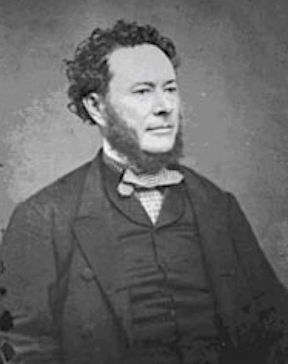 July 7, John A. Macdonald wrote a brief note to his sister, Margaret Williamson, about the event. He said, "You will see by the papers what a narrow escape we had. None of the party will again be nearer their graves until they are paced in them. The people behaved well, the women heroically." He closed his correspondence, concluding that he was "none the worse of the trip," considering his and others' harrowing experiences during the ordeal.
W.H. Smith, captain of the steamer, "Canadian," which rescued the crew and passengers of the "Ploughboy" and towed her to Owen Sound; photo courtesy of Philip Smith and Scott Cameron, Owen Sound
Newspapers also reflected upon the calamity. The [Toronto] "Leader" of July 5 dramatically stated that "Death seemed inevitable — in a few minutes not a soul would be left to tell the tale. Husbands and wives, brothers and sisters, and all friends therefore took a last farewell, commended themselves to providence, and prepared to meet their doom."
In reporting the accident, the July 11 "Chicago Tribune" concluded by saying, “It was escape for all concerned, and our northern brethren feel grateful for this deliverance from calamity."
The "Ploughboy's" July adventure was so newsworthy that it was included in ''Remarkable Occurrences in 1859," published in the Canadian Almanac. The entry said that "the steamer, 'Ploughboy,' with several members of the ministry and other provincial celebrities on board, nearly wrecked on Lake Huron, on her way to Sault Ste. Marie; she drifted all night at the mercy and dragged her anchor until within 20 feet of land." The mishap was also memorialized in a poem entitled, "The Doleful Tale of a Dismal Shipwreck," published in the [Kingston] "Daily British Whig" of July 13.
Eventually, the disabled "Ploughboy" was towed to Collingwood for repairs by the steamer, "Canadian." There, a new cross-head was procured from Buffalo and installed at a cost of $850. While out of service, the steamer, "Racine" (afterwards, "Algoma") took its place on the Fort William route as a fill-in for the "Ploughboy."
In a July 6 letter, the "Ploughboy's" purser, Thomas Wright, said that he had heard that the "Ploughboy" would soon again be in service. By July 7, she took 10 cords of firewood and a load of sheep and steers from Meaford to Bruce Mines. The July 20 [Kingston] "Daily British Whig" noted regular service had resumed, with the "Ploughboy" making a quick trip from Collingwood to Fort William.
In conclusion, the course of Canadian history could have been drastically altered if complete disaster to the "Ploughboy" had not been averted. As a direct result, John A. Macdonald's political career successfully continued, and ultimately, he was knighted June 29, 1867, for his contributions resulting in the confederation of Canada. The "Ploughboy" would return to service on the Great Lakes, and serve in a number of different capacities for 11 more years until its destruction by fire, June 3, 1870, at Detroit.
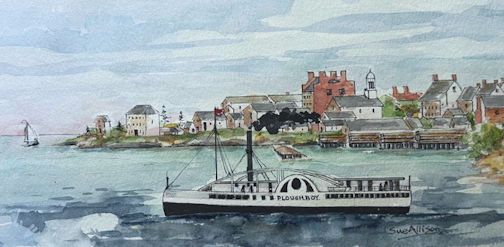
"Ploughboy" leaving Amherstburg for summer quarters in Collingwood, by Grey County artist Sue Allison; photo courtesy of the John Carter collection
Written ByDr. John C. Carter is Peninsula director for the Bruce County Historical Society and author of "The Perils and Pitfalls of the Steamer Ploughboy."
Related Stories
No related stories.